












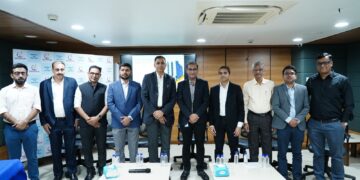











Rajkot, January, 2026: Krishna Defence and Allied Industries Limited (KDAIL) was invited to join the Vibrant Gujarat Region Conference, Saurashtra as a speaker. Gujarat accelerates its journey toward becoming a USD 1 trillion economy by 2047, in line with the vision articulated by the Hon’ble Prime Minister of India. The conference focuses on the Multi-Sector Manufacturing-Export Hub in the Saurashtra Economic Region (SaER) to strengthen export-led industrial growth. The conference, held at Marwadi University, Rajkot, on 11 and 12 January, brought together government, industry, and infrastructure stakeholders to deliberate on building globally competitive manufacturing-export ecosystems.
Speaking at the conference, Mr Ankur Shah, Managing Director, Krishna Defence and Allied Industries Limited, said, “Saurashtra has a strong foundation of export-oriented manufacturing, particularly in engineering-led sectors such as defence, auto components, and precision manufacturing. However, to unlock the region’s next phase of growth, we need integrated manufacturing-export ecosystems that combine scale, infrastructure, logistics, and skilling. A multi-sector manufacturing-export hub can play a catalytic role in bridging this gap and enabling MSMEs to compete more effectively in global markets.”
The inaugural session featured addresses by senior government leadership, including officials from GAD, GIDC, and the Industries & Mines Department, followed by a presidential address by Shri Harsh Rameshkumar Sanghvi, Hon’ble Deputy Chief Minister of Gujarat, underscoring the state’s commitment to export-driven industrialisation.
Saurashtra Economic Region stands as Gujarat’s most influential production core, anchored by export-driven clusters across ceramics and non-metallic minerals in Morbi, brass and salt-chemical value chains in Jamnagar, auto components and engineering in the Rajkot–Jamnagar belt, and cotton textiles and spices in the Surendranagar–Botad region. While the region hosts a high concentration of export-oriented MSMEs, constraints such as limited industrial land beyond GIDC estates and rising logistics costs have emerged as key growth bottlenecks.
The proposed Multi-Sector Manufacturing–Export Hub aims to address these challenges by creating a plug-and-play industrial ecosystem that expands industrial land availability, strengthens rail–port–ICD linkages, and integrates manufacturing-linked services such as design, testing, skilling, and export processing. The initiative aligns with Gujarat’s broader policy framework, including the Gujarat Industrial Policy 2020, Districts as Export Hubs, sector-specific export policies, and the proposed State Export Promotion Council.
The conference brought together senior government officials, industry leaders, policymakers, infrastructure developers, financial institutions, and trade bodies to deliberate on building globally competitive manufacturing-export zones. Key objectives included highlighting investment opportunities in SaER, assessing export potential across defence, ceramics, metals, renewables, and EVs, and capturing industry needs for integrated, multi-sector ecosystems.
There was a panel discussion with leaders from industrial development, zone authorities, global free zone operators, and port-connected infrastructure who discussed the issues and key success factors in the development of large-scale manufacturing-export zones. The issues that were discussed made it clear that the scale, governance models, logistics integration, and long-term planning are crucial to the competitiveness of exports.
The knowledge session pointed out the opportunities in the sectors of defence and aerospace, logistics, renewable energy equipment manufacturing, and auto and EV exports from Saurashtra, thus supporting the notion that the region can become a nationally significant export hub.
The conversations confirmed Gujarat’s desire to change the pattern of fragmented industrial growth and to become the provider of cluster-led, infrastructure-backed export ecosystems that can both unlock MSME scale, facilitate capturing of value, and create long-term jobs.