























Ahmedabad, 5 February 2026: Against the backdrop of the Union Budget 2026 and its renewed focus on skilling, employability, and industry-aligned training, the Future Right Skills Network (FRSN) – ITI Ecosystem Summit 2026 concluded in Gujarat, spotlighting how policy intent and public investment can translate into meaningful career outcomes for ITI learners.
“When we talk about ITIs in India, two narratives come up again and again. One is that ITIs are not aligned to industry and two is that the quality of trainers and training is not what industry needs. But what’s interesting is that these are not uniquely Indian problems. Every country that has built a strong vocational system has faced the same questions. What differentiates the systems that work from those that struggle is one thing. Industry has real skin in the game,” said Nikita Bengani, Director, Youth Program, Quest Alliance, and Director, FRSN.
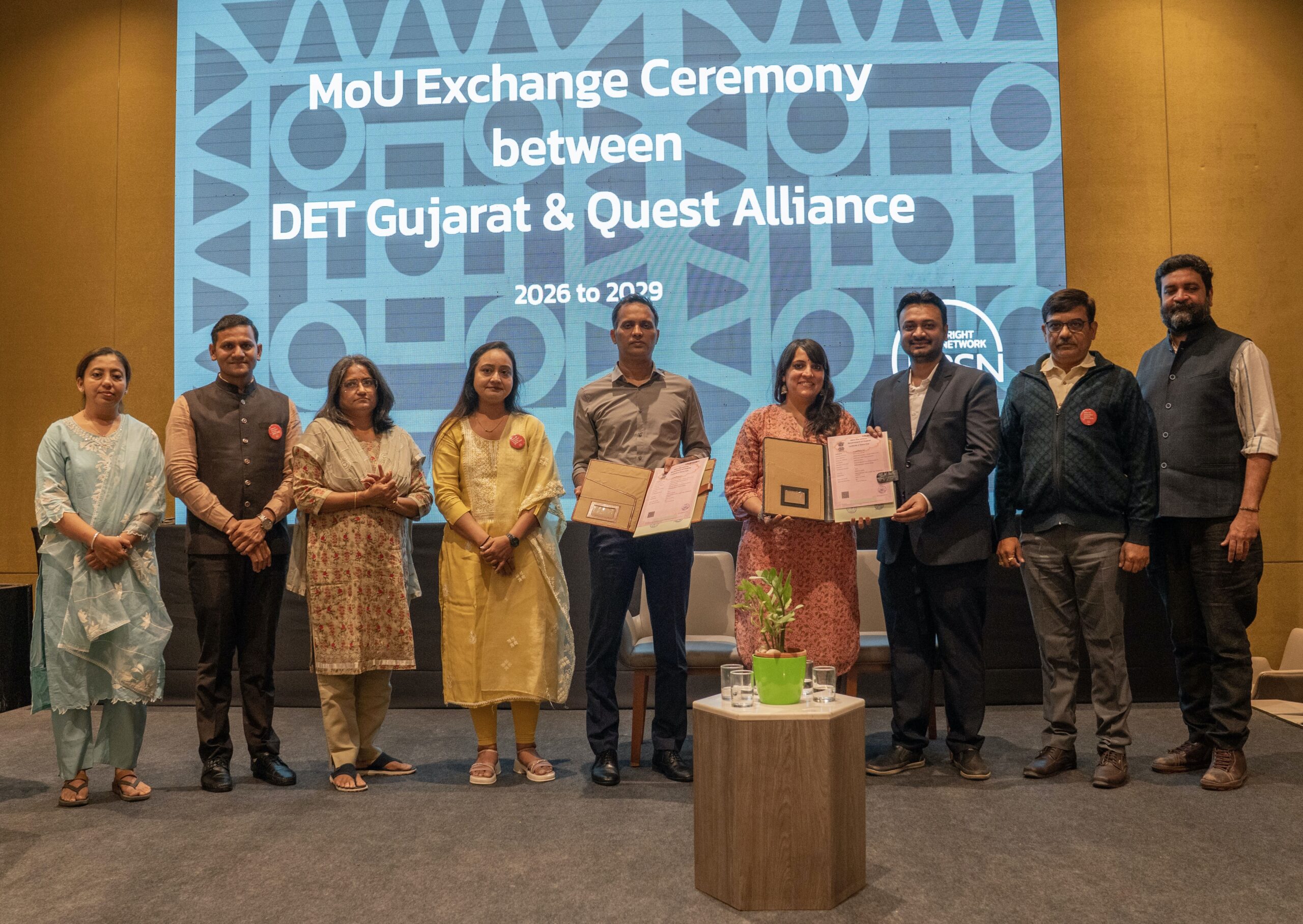
Organised in partnership with the Directorate of Employment and Training (DET), Government of Gujarat, the summit brought together senior government officials, ITI leaders, industry representatives, civil society organisations, ecosystem partners, and ITI learners from across the state. The convening also marked a major milestone as the Directorate of Employment and Training (DET), Government of Gujarat, and Quest Alliance, extended their MoU until 2029. With this, the collaboration enters the tenth year to strengthen learner engagement, digital enablement, placement systems, and industry linkages across Gujarat’s ITI ecosystem.
Delivering the keynote address, Nitin Sangwan, IAS, Director, Directorate of Employment and Training, Government of Gujarat said, “While automation may render some jobs obsolete, vocational skills will remain relevant, and trades will continue to thrive. Therefore, focusing on skill development can secure a bright future for our children. The key challenge lies in motivating instructors; I urge stakeholders to invest in learners’ futures – even a modest 5% increase in effort can transform outcomes for an entire class.”
“The department is currently looking at offering financial incentives for learners to choose trades, to encourage women and persons with disability to choose trades, to promote equity in this space. Principals should also ensure inclusive environments, addressing basic needs like washroom access and privacy, to boost women’s participation,” he added.
An Industry Roundtable, held alongside the summit, discussed how ITI – industry engagement can be strengthened beyond placements to include curriculum relevance, mentoring, learner exposure, and transition support.
“If industry truly has skin in the game, if ITIs are trusted as partners, and if the state plays the role of enabler, the real shift will be not just better training and landing a job but the youth thriving in a rapidly-changing world of work. That’s the kind of system worth building,” she added.
Reflecting the government’s growing focus on learner-centric reforms, the summit amplified ITI learners’ voices, highlighting aspirations for quality jobs, employability skills, and meaningful industry exposure alongside technical training. A Recognition Ceremony honoured 20 learners, trainers, placement officers, and principals from across Gujarat, based on transparent, data-informed criteria developed in consultation with DET Gujarat – focusing on consistent effort and improvement rather than institutional rankings.
The summit concluded with a shared commitment from government, industry, and ecosystem partners to accelerate collaborative action over the coming years – ensuring that policy intent results in tangible, on-ground outcomes for ITI learners across Gujarat.